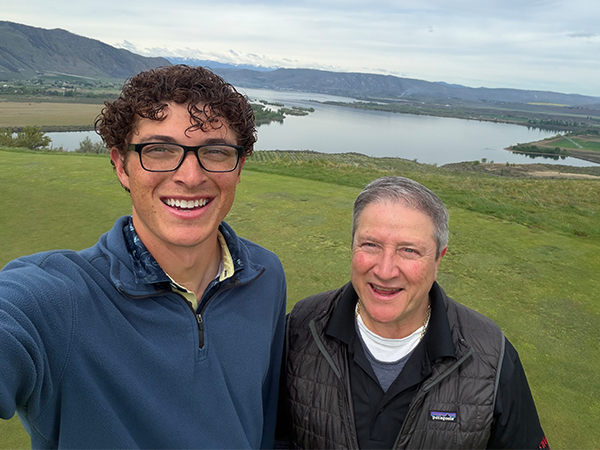
Nikoli “Niko” Omlin didn’t see himself starting college immediately after high school. “I did not want to put myself or my family under financial strain to send me to university if I wasn’t going to make it worth it,” he said. “That said, I refused to stay home; I knew I needed to get out to find opportunity elsewhere.” Niko chose to enlist in the U.S. Army, where he served for four years.
During his service, Niko had the opportunity to meet people from all around the world and to grow in ways that would later support his college journey. He attended and graduated from air assault school and the Mountain Athlete Warrior program, and he completed rappel master certification and drone buster training. He was deployed to Northeastern Syria for Operation Inherent Resolve as a member of Task Force Chosin. “That singular year matured and cultured me as an individual more than the 18 years prior,” Niko said. “The events that unfolded overseas ultimately led me to decide that I wanted more in life than sandstorms and the smell of gunpowder.” When Niko returned to the U.S. and had served his four years, he began learning about the education benefits and opportunities that were open to him. “At this point, I felt confident that I could do what was required in college, and of course it helps that it doesn’t cost me any money,” he said.
Niko separated from the army in April of 2024 and returned to the Wenatchee Valley to start classes at WVC that fall, with the goal of completing his associate of arts-direct transfer degree. He explained that while transitioning from military life to academia can be difficult, he had dealt with worse situations. “It is the understanding that while college may be difficult and may require a lot of grit, it could always be worse, and for many, it is, [and] that got me through my first two years of college and will continue to get me through the next six,” Niko said.
He said many WVC professors had a significant impact on his educational journey and his life, including Professor Richard Brinkman (sociology), Professor Matt Roylance (English), and Professor Hart Johnson (Humanities). “Their curriculum challenged me to think about the world in ways outside of what I would normally do,” Niko said. Dr. Ebenezer Akinterinwa and Professor Hillary Conner helped him to understand science through real world applications, while Professor Scott Volyn taught Business Law in a way that Niko could apply to his future career. He had a particular appreciation for essay writing during his time at WVC, especially writing that allowed him to explore his creativity. “Essays that I wrote at WVC gave me a place to express my emotions and beliefs where I struggled to do so otherwise,” Niko said, and thanked “the professors that continue to allow the highest level of creativity and freedom in their writing projects.”
Niko graduated from Wenatchee Valley College with his transfer degree last June and has since relocated to Arizona to continue his studies at Grand Canyon University. His plans include earning a bachelor’s degree in Government with an emphasis in Legal Studies, and then he will continue on to law school to earn his Juris Doctor and LLM (Master of Laws) in Taxation in order to achieve his final goal of becoming a tax attorney.
Many of Niko’s friends, family members, and mentors encouraged him to consider a law degree. “Though law school, or being a lawyer, had not been on my mind before the countless mentions, the idea grew on me,” he said. “As to how I reached the point where I desire reading tax code for hours on end, I really do not know. And maybe all of my plans will change in the next couple of years; who knows. Life happens, plans change, but it always finds a way to work out.”
Niko encourages other veterans who are attending college to speak up and ask for help
when they need it. “Don’t be afraid to say something. Sometimes the military can instill
the belief that you don’t need to know why, that your questions don’t need to be answered.
Education is not like that,” Niko said. “If you have questions, ask them. If you feel
like something is wrong with the assignment, speak up. If you feel like a professor
isn’t being fair, let them know. Often they are simple mistakes or unconscious efforts.
The more vocal and active the students are, the more responsive the staff will be.”