

- News
- News 2025-2026
- Spotlight on Faculty: Dr. Joan Qazi

Spotlight on Faculty: Dr. Joan Qazi
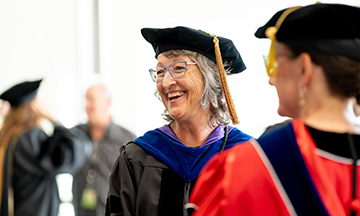 Spotlight on Dr. Joan Qazi // Since Dr. Joan Qazi began teaching geography at Wenatchee Valley College in 1996, she has planted seeds as a dedicated faculty member and the college’s sustainability coordinator that have
grown into essential initiatives that help North Central Washington communities thrive.
Spotlight on Dr. Joan Qazi // Since Dr. Joan Qazi began teaching geography at Wenatchee Valley College in 1996, she has planted seeds as a dedicated faculty member and the college’s sustainability coordinator that have
grown into essential initiatives that help North Central Washington communities thrive.
“I’m a connector,” Professor Joan Qazi shared. “I like thinking about how we can bridge the skills that we all have to build a better community.”
Joan moved to the Wenatchee Valley while she was completing her PhD at the University of Washington. “I decided I wanted to focus my research on something local once my family moved here. And so, I ended up doing my dissertation on women’s work in the apple industry. As a relatively new person living in this region, it was a really good way to get to know the agricultural basis of our community and the key stakeholders.”
Her research led to a lifelong interest in sustainable agriculture, climate justice, and advocating for whole foods. “I have a huge respect for our farming community. They work so hard at all levels, from the farm workers, farmers, and families who help with other jobs so the farm can continue,” Joan said. “It was important to me that we keep diversified farming in the Wenatchee Valley, so farmers can find ways to market their produce locally at farmers markets and with local businesses and schools.”
Joan found a community of like-minded people invested in making a difference locally and helped start the nonprofit EAT! (Education and Agriculture Together). EAT! worked with local school districts to build school gardens throughout the Wenatchee Valley so children could learn how their food was grown and where it came from. By bringing farmers, restaurants, and school districts together, EAT! conducted a community food assessment to find out what was important to our community in terms of food resources. “We learned that there was a strong desire to keep farming in our region so we can all have the benefits of a locally grown food supply.”
Her support of Wenatchee’s local food system marked the beginning of Joan’s deep roots in connecting with our community. “I recently realized this is my thirtieth year teaching at Wenatchee Valley College,” Joan shared with a smile. She cites the importance of working with colleagues who are equally committed to making the college a better and more sustainable place. “When I first started, we had no recycling program, but once Derek Sheffield and other faculty came, we started putting things into motion.” Inspired by Jane Goodall’s Roots & Shoots youth program that educates young people to make a difference in their communities, Joan started her own version at WVC. “Local students in the Roots & Shoots program would collect recycling and we helped take it down to the recycling center behind Sav-Mart and that was the beginning of our recycling program here!” she explained.
After EAT!, Joan served on the board of the Washington State Farmers Market Association and began working as the farm-to-school coordinator for the Washington Sustainable Food & Farming Network (WSFFN). “I did that while I was teaching part-time, and I worked with school districts all the way from Oroville at the Canadian border to Goldendale near Oregon. I put a lot of miles on my Prius, but it was a joy to work with food service directors because I could help connect them with local farmers.”
She credits her experiences working across education, agriculture, and community advocacy with shaping her worldview. Upper Valley Mend’s community harvest and gleaning programs, Joan shared, give back to our community by partnering with local organizations to distribute produce, provide volunteer opportunities, and reduce food waste. Food waste in the United States is estimated to be between 30-40% each year. “Food waste is such a waste when you think about the farm worker’s labor, the water that went into growing that food, and the energy that brought the food from the farm to a family’s table, you know?” Joan said. “It’s all connected and that really sparked in me a big interest in thinking about how we can reduce food waste since it produces methane, which is a greenhouse gas.”
As she learned more about food waste and the methane that it produces, Dr. Qazi recognized the connection to her geography courses, where she had already been teaching students about climate change. “Geography looks at human land interactions, and I had been teaching about climate change since the get go, because it’s a major topic in geography,” Joan explained. “My focus has become more about climate change and how we as scientists can communicate in ways our communities can understand.” Joan’s work as a scientist and educator has helped faculty across Washington state. She teaches faculty how to incorporate climate justice into their curriculum and has advised the State Board of Community and Technical Colleges on their curriculum as well. In this work, she encourages information sharing and a focus on one's own locale, prompting educators and students to ask 'What is happening here locally? How does this impact your life? And what can you do about it?’ More collective action, Joan believes, is what will help move the needle.
“One of the lessons I give to my students is that we can change the status quo,” Joan said. The Wenatchee Valley is the ideal scale for making a positive impact, according to Professor Qazi. “I love this community so much because we’re not too big that you feel you can’t make a difference, but we’re also not so small that new ideas can’t be put into place.” Joan’s local contributions are numerous: she serves on Our Valley Our Future’s Post Carbon Economy steering committee, Chelan County’s Climate Resiliency Strategy education and outreach committee, Sustainable NCW’s Board, and she contributes to the Community and Climate Impact Hub project hosted in collaboration between the University of Washington and Wenatchee CAFE.
Joan's passion for climate justice and hope for a better future came from her father, who instilled within her a love of the outdoors. “We went hiking every weekend and my connection is to the natural world. I think that’s really the starting point for me,” she said.
The motto Joan lives by as a geographer and educator is to think globally and act locally. “It’s not enough just to teach about the concepts. It’s important that we make a difference in our own community and see how interconnected we really are. I encourage others to think about what food waste and climate change mean for our community and to try to address these issues locally.”
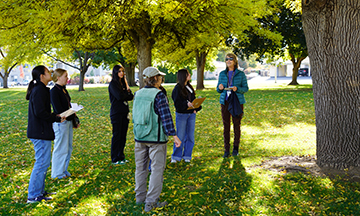 Through her work as WVC’s sustainability coordinator, Joan has emphasized how our
faculty, staff, and students are working together to make the college a better and
more sustainable place. “Our sustainability committee is a good mix of students, staff,
and faculty. That’s such a great combination because it is student-driven and it flows
into the rest of our faculty and staff who can help bring their ideas to life,” she
said.
Through her work as WVC’s sustainability coordinator, Joan has emphasized how our
faculty, staff, and students are working together to make the college a better and
more sustainable place. “Our sustainability committee is a good mix of students, staff,
and faculty. That’s such a great combination because it is student-driven and it flows
into the rest of our faculty and staff who can help bring their ideas to life,” she
said.
“I want to highlight our Omak campus as well, because I’ve worked with wonderful colleagues up there,” she continued. “Our community is all of our students who live between our campuses, and that brings us together. Having Omak students in my online sustainability class has helped me learn about sustainable organizations up in Okanogan County too.”
Joan's role as sustainability coordinator is a pivotal part of Wenatchee Valley College's vision for a more sustainable region. By bringing together students, faculty and staff, she has successfully helped WVC reduce waste through recycling and composting programs, promoted reuse through hydration stations and clothing swaps, maintained our Tree Campus USA Higher Education status, worked toward the National Wildlife Federation’s certificate in plastic reduction, and addressed our carbon footprint by promoting public transit, bicycling, and walking to campus. Through events and campus sustainability initiatives, she helps raise awareness about these issues on campus and in our broader community.
Professor Joan Qazi will open Wenatchee Valley College’s reimagined WVC Speaks lecture series on Thursday, January 22 with Sustainable NCW Executive Director Marlene Farrell in a talk on “What Our Emissions Tell Us.” Their presentation will take place at the Music and Art Center’s Grove Recital Hall at 6 p.m.
“I hope people walk away with a better understanding of the science behind greenhouse
gases and how we can all get involved to make our community a more climate-resilient one,”
Joan shared.
Professor Joan Qazi’s Reading List
- Not the End of the World: How We Can Be the First Generation to Build a Sustainable Planet, Hannah Richie