

- News
- News 2025-2026
- Spotlight on Faculty: Dr. Kestrel Smith

Spotlight on Faculty: Dr. Kestrel Smith
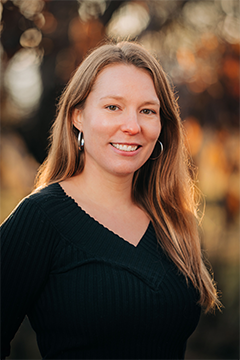 SPOTLIGHT ON FACULTY // “We couldn’t have the United States without the Indigenous story,” said Dr. Kestrel
Smith, professor and program chair of the American Indian Indigenous Studies (AIIS) program at Wenatchee Valley College Omak. In the nine AIIS courses that she
teaches throughout the academic year, Dr. Smith covers the traditional North American landscape and lifestyles, Euro/American colonization,
Indigenous decolonization, Indigenous literature and film, gender studies, and more. “It’s all our shared history because it’s part of our story of how we came to be,”
she said.
SPOTLIGHT ON FACULTY // “We couldn’t have the United States without the Indigenous story,” said Dr. Kestrel
Smith, professor and program chair of the American Indian Indigenous Studies (AIIS) program at Wenatchee Valley College Omak. In the nine AIIS courses that she
teaches throughout the academic year, Dr. Smith covers the traditional North American landscape and lifestyles, Euro/American colonization,
Indigenous decolonization, Indigenous literature and film, gender studies, and more. “It’s all our shared history because it’s part of our story of how we came to be,”
she said.
Kestrel learned fragments of the Indigenous story as a child, but not the whole story. “I grew up in Virginia, where our history books gave us the Williamsburg and Jamestown stories, and in those stories, the occasional Indigenous character on the sidelines supporting the colonist story,” she explained. “In fourth grade, my brain could only process that it was not necessarily the whole story or the right story or, you know, that things had been done during that time that didn’t sit well with me.”
She took her first American Indian Studies (AIS) course at Virginia Tech and, in her words, couldn’t get enough of it. She decided to minor in AIS, as no major was available at that time. Two years after graduating with her bachelor’s degree, she decided to go back to school, so she packed and drove to Tucson, Arizona, where she attended the University of Arizona.
“I fell in love with the field of American Indian Studies even more while I was there,” she said. She earned both her master’s and doctoral degrees from the University of Arizona’s American Indian Studies program. She focused her master’s thesis work on Tribal Colleges and Universities (TCUs), which blend cultural components into the curriculum. For example, a TCU student studying biology might also learn canoeing while harvesting and studying wild rice, which grows on the water. When students from TCUs graduate, they have not only a degree but a cultural context that is reflective of people and place. During her studies, Dr. Smith worked with several Indigenous communities, including Diné College on the Navajo reservation, Comanche Nation College, Tohono O’odham Community College, and with the Pascua Yaqui tribe.
She also minored in the Higher Education program, though at the time, she didn’t see herself as a teacher. Now, as a professor of American Indian Indigenous Studies, she said she “can’t imagine being anywhere else doing anything else, which is a wonderful thing to be able to say.”
Dr. Smith was hired at Wenatchee Valley College Omak in the fall of 2018 to build and then teach the AIIS program. The program expanded from a couple of history courses about the Indigenous story to the nine AIIS-specific courses that are now offered.
“The Indigenous experience in Washington was something that I had to learn a lot about when I first came here,” Kestrel said. “And I was very fortunate and blessed to have amazing community members here who were willing to share their insights and their connections and their community with me. I could not have done it without those things.”
“I have students who come into my classroom and AIIS is entirely new to them,” she continued. “They are presented with this opportunity to engage and to see our world and our society with an entirely different lens. Other times I have students for whom much of what we talk about in my AIIS classes are lived experiences.... It’s a part of their daily life, part of their family dynamic, part of their personal history. But, in examining these things that they experience on a daily basis through the lens of the classroom, they often find that self-reflection. They find explanations for why things are the way they are in their family dynamics or their communities. They find connection to these things in a different way, a connection to what we talk about in classes in a very personal and very relevant way.”
If the AIIS courses are a way for students to better understand themselves, they also present the opportunity to create collective change. “I myself can look around and see these things that I'd love to see changed in our society, in our life or world, but as an individual I can't just up and change those things.... I can't change the world as one person, but we can help build collective change,” Kestrel said. “And my hope is, every student will take this information forward in their own way. And that is why I teach, because little by little we can build that greater awareness. We can start to push for that collective change, and through that collective push we can hopefully bring about social justice, social change, fixing the things that we say we want to see fixed in the world.... And that is why I teach.”
Dr. Smith also makes her position clear to her students and community: “Anytime I start my classes or presentations, I’m very upfront about my positionality as a teacher, as a speaker, and my positionality is that of a non-Native ally. I’m not Indigenous. My job, therefore, is not to speak for Native peoples; I can’t.... My job is to share facts, to share tools with which to engage in those facts and a space within which to do that.”
Kestrel will give the second lecture in the WVC Speaks Lecture Series on Thursday, Feb. 19, at 6 p.m. in The Grove Recital Hall on the Wenatchee campus. She will present “Fish Wars: Tribal Rights and Resiliency in the Pacific Northwest,” a talk that she created at the request of Humanities Washington Speaker’s Bureau (2024-2025).
Her “Fish Wars” presentation is a condensed version of the first five weeks of the AIIS 103: Indigenous Pacific Northwest course. “I just watched my students really connect to the content and find a lot of ‘a-ha!’ moments in that class,” she said. “And it’s an important conversation for all Washingtonians to understand.”
One of the misconceptions that Smith said she heard when first moving to Washington is the idea that Native fishing threatens resources and is considered unfair by some. “And that doesn’t sit well with me because first and foremost, they were absolutely here first. Second of all, Native fishing always has been and is still sustainable. There is relationship there. There is respect and reciprocity there,” Kestrel explained.
The Fish Wars were a period in the 1960s and 1970s, when tribes throughout the Pacific Northwest launched protests and acts of civil disobedience to pressure the government to recognize their fishing rights. The lessons from these events—including tribal sovereignty, treaties, statehood, and the fish themselves—remain relevant today. In her presentation, Dr. Smith will survey the evidence and events before and after the Fish Wars, which rocked Washington state for decades. Understanding these events is a first, and essential, step in achieving social, cultural, and political justice.
She hopes that during the presentation her audience will gain an understanding of the legal framework of the Fish Wars. “One of the things I tell my audiences, my students, [and] in the Fish Wars talk [is] that as Washingtonians...it doesn't matter whether you're Indigenous or not, these things pertaining to treaty rights and fishing rights impact all of our lives, and it's important to understand those things…. It's an opportunity to see our shared histories in a more meaningful way.”