

- News
- News 2025-2026
- Spotlight on Staff: María I. Morales-Sánchez

Spotlight on Staff: María I. Morales-Sánchez
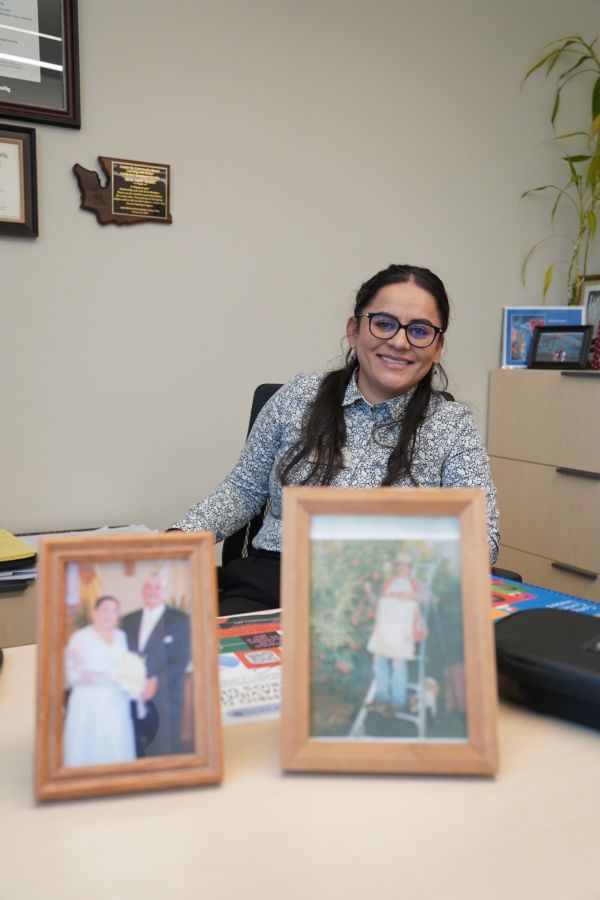
Dr. María Morales-Sánchez is pictured at her desk with photos of her family, including her grandparents.
“I think our role as educators here in this community is to make sure our community knows their dreams are tangible and that we're here to help students figure that out in real time,” said Dr. María Morales-Sánchez, director of El Corazón Center for Teaching and Learning at Wenatchee Valley College. Dr. Morales-Sánchez is the first in her family to earn a doctorate and has spent years thinking about education. With family roots stretching from Michoacán, Mexico to the Wenatchee Valley, she’s found that positive educational experiences start with a sense of belonging.
At her dual language elementary school in California, María recalls that “school was a safe place for me.” In first grade, Mrs. Johnson invited María and her mother over for hot chocolate, and María’s teachers validated her use of Spanish, her first language, while slowly introducing her to English. These affirming experiences helped María build a strong sense of self, particularly her immigrant identity: “One of the things I'm most proud of is being a Spanish speaker [and] being bilingual.”
María’s fourth-grade teacher, Mrs. Anthony, sowed similar seeds of belonging. “From day one, she made it clear to a class of mostly low-income students and students of color that in her classroom, we all had a chance,” María shared. Mrs. Anthony also held high expectations of her students, and these kinds of educators, as Dr. Morales-Sánchez would later learn, have a name: warm demanders. Quoting educator Lisa Delpit, Dr. Morales-Sánchez explained that warm demanders know how to “convince students of their own brilliance.” With this support, María developed a love for reading and began to harbor a dream to one day be a teacher.
When she moved to the Wenatchee Valley at the age of sixteen, María entered a new social scene that was smaller and less diverse than in California. She recalls her and her friends being discouraged from using Spanish in a private conversation on the grounds that it interfered with their ability to learn. When she expressed interest in college, her school counselor replied, “I don’t think you’ll make it,” until she saw María’s good grades and changed her message.
María was college-motivated, but she didn’t have anyone in her family to show her the way. One day, a College Migrant Assistance Program (CAMP) recruiter from Eastern Washington University (EWU) visited her school to help students apply. “I had this dream, but no one in my life ever told me how that could even happen. So, dreams are important and you also need people. You need some strategy, some steps and how to do it,” said María. Her English teacher, Mr. Morrison, also helped by arranging a trip to Eastern that continued to open doors for María.
At EWU, María pursued an interdisciplinary major with a sociology emphasis, and minored in Spanish and Chicano studies. She discovered helpful support networks in Eastern’s CAMP and TRiO programs, from logistical assistance to navigating the pressures of being a first-generation college student. During her junior year, María applied to study abroad in Mexico with The Mexico Solidarity Network. “I felt like I didn't know a lot about the country where I was born,” she said. In Chiapas, Mexico, María studied Mexican history and social movements, and the experience was so moving that she knew she wanted to pursue a doctoral program in education.
It was this same trip that introduced María to Brazilian Pedagogy expert Paolo Freire. Reading Pedagogy of the Oppressed helped her connect academic ideas with the lived experiences of the Indigenous people she was interacting with. She saw firsthand the potential of what Freire meant by teaching students to “read the world and read the word,” that is, empowering people to examine their own realities critically, contextually, and culturally.
Inspired by her studies and still in love with reading and research, María earned her doctorate in Cultural Studies and Social Thought in Education from Washington State University in 2015. Her dissertation, titled “Conocimiento y Testimonio: An exploratory case study of Mexican American children of (im)migrants learning with(in) cherry orchards,” draws on a child-centered framework to challenge deficit-based understandings of children of immigrants.
Upon graduating, Dr. Morales-Sánchez began her career as program manager at Gonzaga University’s Unity Multicultural Education Center where she worked for a few years before landing a tenure track position at The Evergreen State College. At Evergreen, she tested Freire’s ideas in her Latinx studies and education courses; namely, moving away from a “banking education” mode–in which knowledge is deposited from teacher to student–and moving toward an approach in which students see themselves as both teachers and learners. “Sometimes we do a little lecture and that's important…other times, we have [students] teach each other…and that is what helps students build a relationship to learning that is positive,” she shared.
Evergreen also provided Dr. Morales-Sánchez with a unique opportunity to explore community-building: the Gateways for Incarcerated Youth program, a partnership between Evergreen and The Greenhill School, a medium to maximum juvenile correctional facility in Chehalis, WA, founded on the idea of participatory learning. The onset of the COVID-19 pandemic, however, forced Dr. Morales-Sánchez and her students to move online. As for many, this presented challenges, but for Dr. Morales-Sánchez, the mission remained the same: adapt to the needs of the learning community that fostered intellectual curiosity and help everyone find belonging.
When Dr. Morales-Sánchez returned to the Wenatchee Valley in 2023, she began to feel a different sort of connection to the valley: “As I [had] more space to develop myself and my own thinking, I started really [having] more of an appreciation for this valley as my hometown. My family was here.”
In 2023, WVC was awarded a federal Title V grant to improve outcomes and institutional culture for Latino/a, low-income, and first-generation students at WVC, and to move toward what Hispanic-Serving Institution (HIS) scholar Dr. Gina García labels ‘servingness’. Dr. Morales-Sánchez was hired as the inaugural director of El Corazón (the heart) Center for Teaching and Learning in 2025.
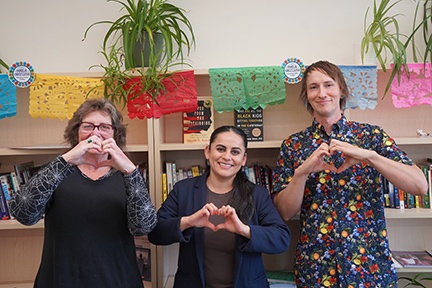
Dr. María Morales-Sánchez is pictured (center) with Barbara Oldham and Saxon Spillman.
As director of El Corazón, Dr. Morales-Sánchez wants to create spaces for students, faculty, and staff that allow the entire WVC community to feel a sense of belonging. She’s hosted faculty workshops on culturally responsive pedagogy (and wants to do more) and she invites students to study at El Corazón in Mish ee twie, and. She also recently launched a Lunch & Learn discussion series, where the first event centered on teaching at an HSI.
Dr. Morales-Sánchez places humility at the center of her vision for El Corazón. For instructors, suggested María, this could be “checking in with learners again and again [and] being willing to let go of something that is not working because the students have told you it's not working.” For students, it might be learning to not just take notes in class, but actually “noticing each other as a community.”
At the institutional level, Dr. Morales-Sánchez envisions El Corazón as a resource for faculty and staff to better understand the context of Latino students and what it means to be an HSI. She acknowledged that many Latino students don’t transfer to universities after completing their two-year degrees, and she wants El Corazón to guide those who may need more support. Having left home and come back, María has learned that she can prioritize personal growth and community connections at the same time, and she wants young people to see all of their options. “Let’s give [our students] tools to grow and contribute positively to our community,” she offered, “so they can figure out how to use their voice and how to use what they’ve learned to support and contribute to positive community development.”
Dr. Morales-Sánchez will share what she has learned about immigration and belonging in her upcoming lecture, “Carrying Home: Immigration and Mexican Belonging in the Wenatchee Valley” at the next WVC Speaks Lecture Series event on March 12 at 6 p.m. In this lecture, she will use storytelling to highlight the nuanced stories of Mexican immigrants in the Wenatchee Valley.
From her leadership role at WVC to her upcoming WVC Speaks lecture, Dr. Morales-Sánchez wants WVC students to have their own ‘warm demander,’ someone who shows them that they belong: “Community is connection, like human connection,” she explained. “Being student-centered means seeing students as humans first, right?”
La Dra. María Morales-Sánchez sentada en su oficina con fotos de su familia, incluyendo de sus abuelos.
“Creo que nuestro papel como educadores aquí en esta comunidad es el de asegurar que nuestra comunidad sepa que sus sueños son tangibles y que estamos aquí para ayudar a los estudiantes a averiguarlo en tiempo real,” dijo la Dra. María Morales-Sánchez, directora de El Corazón Center for Teaching and Learning en Wenatchee Valley College. La Dra. Morales-Sánchez es la primera en su familia en obtener un doctorado y lleva años reflexionando sobre la educación. Con raíces familiares que se extienden desde Michoacán, México al valle de Wenatchee, ha aprendido que las experiencias educativas positivas nacen de un sentido de pertenencia.
En su escuela primaria en California, que era un programa de inmersión bilingüe, María recuerda que “la escuela era un lugar seguro para mí”. En el primer grado, la Señora Johnson invitó a María y su mamá a tomar un chocolate, y los maestros de María valoraron su uso de español, su lengua materna, mientras le introducían al inglés paulatinamente. Estas experiencias afirmativas sirvieron para que María construyera un fuerte sentido de sí misma, y en particular, su identidad de inmigrante: “Una de las cosas de las que estoy más orgullosa es ser hispanohablante y ser bilingüe”.
La maestra de cuarto grado que tuvo María, la Señora Anthony, sembró semillas de pertenencia semejantes. “Desde el primer día, quedó claro a la clase entera, que era en su mayoría estudiantes de bajos ingresos y estudiantes de color, que todos teníamos potencial”, compartió María. La Señora Anthony también mantenía expectativas altas de sus estudiantes, y este tipo de educadores, como eventualmente aprendería María, tiene un nombre: maestros exigentes con cariño. Citando a la educadora Lisa Delpit, la Dra. Morales-Sánchez explicó que los maestros exigentes con cariño saben “convencer a los estudiantes de su propia inteligencia”. Con este apoyo, María desarrolló un amor por leer y comenzó a nutrir un sueño de ser maestra algún día.
Cuando se mudó al valle de Wenatchee a la edad de dieciséis años, María se incorporó a un ambiente social nuevo, lo cual era más pequeño y menos diverso que el de California. Recuerda que una vez estaba teniendo una conversación privada con sus amigas en español, y un maestro les aconsejó que dejaran de hablar en español con el razonamiento de que interfería en su habilidad de aprender. Cuando expresó interés en asistir a la universidad, la consejera de la escuela le replicó con “No creo que lo alcances”, pero al ver las buenas notas de María, cambió su mensaje.
María tenía ganas de asistir a la universidad, pero no tenía a quien encaminarla. Un día, un reclutador del Programa de Asistencia de Colegio para Migrantes (CAMP, por sus siglas en inglés) de Eastern Washington University visitó su escuela para ayudar a los estudiantes a solicitar admisión. “Tenía este sueño, pero nadie en mi vida me había dicho cómo podría convertirse en realidad. Así que, los sueños son importantes, pero uno también necesita de las personas. Necesita alguna estrategia, algunas instrucciones y cómo hacerlo,” dijo María. Su maestro de escritura, el Señor Morrison, también ayudó al planear un viaje a Eastern que hizo que las puertas siguieran abriéndose para María.
En Eastern, María se especializó en estudios interdisciplinarios con un énfasis principal en sociología y un énfasis secundario en español y estudios chicanos. Descubrió una red de apoyo en los programas CAMP y TRiO que tenía Eastern que resultaban útiles con asuntos de logística y también al navegar las presiones de ser una estudiante universitaria de primera generación. Durante su tercer año, María solicitó entrada en un programa de estudiar en el extranjero a través de la Red de Solidaridad con México. “Sentía que no sabía mucho del país donde nací”, dijo. En Chiapas, México, María estudió la historia de México y los movimientos sociales, y la experiencia fue tan conmovedora que entonces supo que quería realizar un programa de doctorado en educación.
Fue ese mismo viaje en el que María conoció las obras del experto de pedagogía brasileño Paolo Freire. Al leer Pedagogía del oprimido, María pudo vincular lo académico con las experiencias de vida de los indígenas con quienes interactuaba. Vio de primera mano las posibilidades de lo que señalaba Freire con enseñar a los estudiantes a “leer el mundo y leer la palabra,” es decir, empoderar a las personas a analizar sus propias realidades crítica, contextual y culturalmente.
Inspirada por sus estudios y todavía enamorada de la lectura y la investigación, María obtuvo su doctorado en estudios culturales y pensamiento social en educación de Washington State University en 2015. Su tesis, titulada “Conocimiento y Testimonio: An exploratory case study of Mexican American children of (im)migrants learning with(in) cherry orchards” se basó en un marco teórico que coloca al niño en el centro para desafiar las perspectivas basadas en el déficit sobre los niños de inmigrantes.
Al graduarse, la Dra. Morales-Sánchez emprendió su carrera cuando fue contratada como gerente de programas en el Unity Multicultural Education Center en Gonzaga University donde trabajó unos años antes de ser contratada como profesora en camino de obtener la permanencia en The Evergreen State College. En Evergreen, puso a prueba las ideas de Freire en sus cursos de estudios latinx y educación; a saber, se alejó de la “educación bancaría” en la que una maestra solo deposita conocimientos en estudiantes y se movió hacia un estilo en el que los estudiantes pueden verse como maestros y aprendices a la vez. “A veces hacemos presentaciones tradicionales, y son importantes…en otros momentos, pedimos a los estudiantes que se enseñen el uno al otro…y eso es lo que les ayuda a construir una relación con el aprendizaje que sea positiva”, dijo.
Dar clases en Evergreen también le brindó a la Dra. María Morales-Sánchez una oportunidad única para fomentar un sentido de comunidad: el prorgrama Gateways for Incarcerated Youth, una asociación entre Evergreen y la Greenhill School, un centro penitenciario de entre mediana y máxima seguridad ubicado en Chehalis, WA, basado en la idea del aprendizaje participativo. Cuando estalló la pandemia de COVID-19, sin embargo, la Dra. Morales-Sánchez y sus estudiantes tuvieron que hacer todo en línea. Igual que para muchos, esto conllevó desafíos, pero para la Dra. Morales-Sánchez, la misión seguía igual: adaptarse a las necesidades de la comunidad que generaban la curiosidad intelectual y ayudarlos a todos a sentir que pertenecían.
Cuando la Dra. Morales-Sánchez regresó al valle de Wenatchee en 2023, empezó a sentir una conexión diferente al valle: “A medida que tenía más espacio para desarrollarme a mí misma y mi forma de pensar, empecé a apreciar aun más el valle como mi pueblo. Mi familia estaba aquí.”
En 2023, WVC recibió una subvención del Título V del gobierno federal con el fin de mejorar los resultados y la cultura institucional de estudiantes latinos, de bajos ingresos y de primera generación en WVC, y también acercarse a lo que la académica especializada en las instituciones de servicio a los hispanos (HSI, por sus siglas en inglés) llama en inglés ‘servingness’. La Dra. Morales-Sánchez fue contratada como la directora inaugural de El Corazón Center for Teaching and Learning en 2025.
La Dra. María Morales-Sánchez la de en medio con Barbara Oldham y Saxon Spillman.
Como directora de El Corazón, la Dra. Morales-Sánchez quiere crear espacios para estudiantes, profesores y personal que permitan que la comunidad entera de WVC sienta un sentido de pertenencia. Ha ofrecido talleres de pedagogía culturalmente relevante (y quiere hacer más) e invita a los estudiantes a estudiar en El Corazón, ubicado en Mish ee twie. También lanzó recientemente una serie de pláticas de almuerzo; la primera sesión se centró en la enseñanza en las HSI.
La Dra. Morales-Sánchez coloca la humildad en el centro de su visión para El Corazón. Para los profesores, sugirió María, esto podría ser “hacer seguimiento con los estudiantes una y otra vez y estar dispuestos a dejar de hacer algo porque no funciona y los estudiantes han dicho que no funciona”. Para los estudiantes, podría ser aprender a no solo tomar apuntes en clase, sino también “fijarse en quién forma la comunidad a su alrededor”.
A nivel institucional, la Dra. Morales-Sánchez aspira a que El Corazón sea un recurso para el profesorado y el personal que les ayude a mejor entender el contexto de los estudiantes latinos y qué significa ser HSI. Reconoció que muchos estudiantes latinos no se transfieren a universidades después de completar sus títulos de dos años, y quiere que El Corazón los guíe a aquellos que tal vez necesiten más apoyo. El hecho de que haya salido y regresado le ha ayudado a María a aprender que puede priorizar el crecimiento personal y las conexiones comunitarias al mismo tiempo, y quiere que los jóvenes vean todas las opciones que tienen disponibles. “Que demos a nuestros estudiantes las herramientas para crecer y contribuir de manera positiva a nuestra comunidad”, ofreció, “para que puedan determinar cómo hacer oír su voz y utilizar lo que han aprendido para apoyar y contribuir al desarrollo comunitario de una manera positiva”.
La Dra. Morales-Sánchez compartirá lo que ha aprendido sobre la inmigración y la pertenencia en su presentación, “Carrying Home: Immigration and Mexican Belonging in the Wenatchee Valley”, que forma parte de la serie de charlas WVC Speaks y tendrá lugar el 12 de marzo a las 6:00 p.m. En esta presentación, recurrirá a los cuentos familiares para iluminar las historias matizadas de los inmigrantes mexicanos en el valle de Wenatchee.
De su puesto como líder en WVC a su próxima charla de WVC Speaks, la Dra. Morales-Sánchez quiere que los estudiantes de WVC tengan sus propios maestros exigentes con cariño, personas que les demuestran que pertenecen: “Comunidad es conexión, como conexión humana”, explicó. “Tener el enfoque centrado en el estudiante quiere decir ver a los estudiantes como humanos primero, ¿verdad?”