

- News
- News 2025-2026
- Spotlight on Faculty: Sarah Sprouse

Spotlight on Faculty: Sarah Sprouse
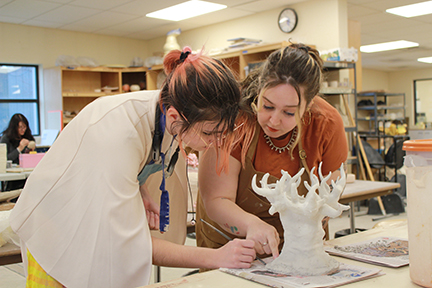
Wenatchee Valley College ceramics instructor Sarah Sprouse knew she wanted to become an art educator from a very young age. “When I was in high school, I wanted to go right into art education,” she said. “I love the transformative power of art. That’s a big saying that comes forward from my heart because art is universal, and it builds bridges.” She wanted to create a space where other people could experience art.
Sarah’s art journey began with painting. She didn’t discover ceramics until she was a college undergraduate, when she attended the Grünewald Guild in Leavenworth. There, she took a one-day ceramics class. “I thought, this is the weirdest, coolest thing ever. I want to do more of this,” she said, explaining that the class altered the art path she was on. From then on, she began working with ceramics more than painting.
She attended the University of Montana and Azusa Pacific in California, earning a Master of Art in Art History and a Master of Fine Arts in Ceramics. Sarah began teaching as an undergraduate at the University of Montana, and then her teaching experiences expanded into a variety of areas, from elementary school to the Grünewald Guild, where she not only teaches but serves as the director. She began teaching the full sequence of ceramics classes at WVC in 2024. "I've taught art in every level possible, which has been really fun and informs how I teach still,” she said.
She approaches her classes with playfulness in mind. “I really want them [the students] to take a playful explorer approach to ceramics, to try something new or something they didn’t think they’d necessarily be able to make,” Sarah said. “And I found that’s very helpful when teaching adults as well is coming from a more playful approach so that way they have something to enter into, and it feels a bit less scary.”
Visitors to the WVC ceramics lab may find not only bowls and plates, but mugs that resemble sea creatures and faces, elaborate vases decorated with koi and flowers, miniature houses, cat and tree sculptures, pugs (both tiny and life-size), and much more. “We encourage weird art in this classroom,” Sarah said, adding that TikTok and other social media trends have inspired her students’ work. “I love when someone comes in because they saw a video, and I’m like, ‘Okay, let’s take that excitement and enthusiasm and hold on to it. And you’re gonna be in for a really exciting ride,’” she said.
Sarah added that “ceramics is inherently collaborative and community-based, so it works very well in our college spectrum. Having such diverse students in age and demographics and backgrounds...everyone gets really inspired by each other, which is cool. We get to witness each other’s wins and how resilient they can be.”
She wants her students to understand that ceramics doesn’t only involve working with clay on a wheel; it is an entire spectrum, from its history to the discussion about whether ceramics is design or art. “I want students to walk away thinking more about ceramics and those kind of core concepts of what is art? What is sculpture? What is craft?” she said.
The community will also have the opportunity to learn more about ceramics history at Professor Sprouse’s upcoming WVC Speaks Lecture on April 23, “Modern Craftsmen: Women, Ceramics, and Community in the Pacific Northwest.” The discussion will address a vital and often overlooked chapter of modern art history. Long marginalized within the canon of modernism, ceramics offered women a rare and powerful site of artistic freedom at a time when they were largely excluded from painting and sculpture. In the postwar era, women ceramicists reframed artistic practice as a form of knowledge production—shifting the conversation about art from object to process, from product to practice.
Women’s history and ceramics are important topics for Sarah. Embedded within the broader question about what defines craft vs. art is the question about where women fit in. In modern art history, “it was mostly men who were in exhibition spaces, whereas women were the teachers, and so I explore women’s ceramics history and special community,” Sarah explained. At a point when ceramics and sculptures were finally considered fine art, many ceramics shows and exhibitions were cancelled due to a perceived lack of quality in the work. “The women were like, ‘Where can we show our work?’” Sarah said. The result was that many women began to create their own arts spaces. “Most of our community studios, our community spaces, were started by women with all women, and that is really interesting to me,” she said. Betty Woodman, one of Sarah’s inspirations and the artist on whom she focused her research, was the first living woman ceramic artist to have her own solo exhibition at The Metropolitan Museum of Art in 2006.
Professor Sprouse shares her knowledge about women artists and craft history with not only students and our community but the broader art world as well. She was recently part of a symposium in Chicago, where she discussed modernism and icons. This spring, she traveled to Cambridge, England to talk about craft history and how it has evolved, with a particular focus on the West Coast and the Pacific Northwest.
In addition to these talks, Sarah will attend an artist residency in Mexico City this summer and another in Japan next summer. She will also have her own solo exhibition in Spokane next January.
Working with clay, Sarah said, requires students to be in the present moment, and it allows them to see and touch something that they made with their own hands. “Art can be transformative, but I’m not assuming that everyone who comes in here is going to leave a changed person,” she said. “But I hope that they feel more grounded in who they are and that they’re more capable than they think.”